

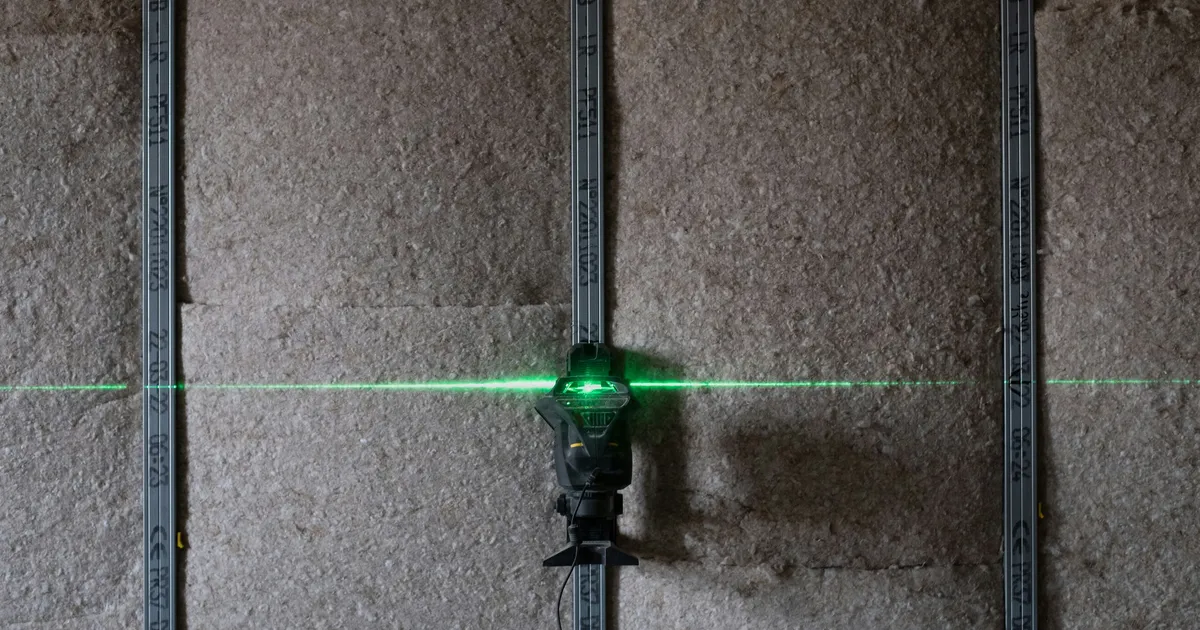

Determining the optimal instrument between a laser level vs traditional bubble level for hanging shelves involves evaluating the intersection of geometric precision and operational efficiency. In the high-stakes environment of structural carpentry, the traditional spirit level relies on the principles of hydrostatic equilibrium within a sealed vial, providing a tactile, gravity-referenced datum that remains immune to electronic interference. Conversely, modern laser projection systems utilize high-intensity diodes and self-leveling gimbals to cast an architectural-grade reference line across multiple planes simultaneously. As we progress into 2026, the integration of micro-electromechanical systems (MEMS) has further refined these tools, allowing for tolerances that were previously unattainable in residential applications. This article explores the mechanical nuances, photonic properties, and ergonomic considerations necessary to select the correct tool for ensuring shelf stability and aesthetic alignment across complex interior topographies.
Mechanical Principles of Spirit Leveling
The traditional bubble level, or spirit level, operates on the fundamental principle of buoyancy within a curved glass or plastic vial. This vial is typically filled with a low-viscosity liquid, such as ethanol or a specialized hydrocarbon spirit, which contains a single bubble of air or inert gas. Because the internal surface of the vial is ground to a precise longitudinal radius, the bubble naturally seeks the highest point of the arc, which corresponds exactly to the terrestrial horizontal plane. Engineers value this tool for its “absolute” nature; it requires no calibration against external digital standards and provides a direct physical response to gravitational forces. For shelf installation, this translates to a reliable, localized measurement that is unaffected by ambient light or battery depletion.
However, the efficacy of a spirit level is often limited by the phenomenon of parallax error and the physical length of the tool’s frame. When a technician views the vial from an oblique angle, the perceived position of the bubble relative to the graduation marks can shift, leading to an angular deviation in the shelf’s placement. Furthermore, a standard 24-inch or 48-inch level can only verify the flatness of the span it physically covers. To project a level line across a ten-foot wall, the user must leapfrog the level, a process that introduces “stacking tolerances” where minor errors in each placement accumulate into a significant total deviation. For high-precision requirements, referencing NIST Weights and Measures guidelines can help in understanding the calibration standards for these manual instruments.
Photonic Projection and Laser Diode Technology
Laser levels represent a paradigm shift in layout technology by utilizing semiconductor diodes to emit a concentrated beam of coherent light. In the context of 2026-grade hardware, most professional units employ green-beam technology (typically 520nm wavelength), which offers significantly higher visibility to the human eye compared to traditional red-beam diodes. These devices are mounted on a self-leveling pendulum assembly, which uses gravity to pull the laser source into a true vertical or horizontal orientation. Magnetic induction dampening is frequently employed to stabilize the pendulum quickly, allowing the user to project a perfectly level datum line across an entire room within seconds of activation. This eliminates the need for manual marking and leapfrogging required by spirit levels.
The technical advantage of a laser level vs traditional bubble level for hanging shelves lies in the “constant reference” it provides. Once the laser is mounted on a tripod or tension pole, it casts a continuous, hands-free line that serves as a visual guide for drilling, bracket placement, and final shelf alignment. This allows for a “point-to-point” accuracy that is theoretically superior over long distances, as the beam divergence is kept to a minimum (often less than 1/8 inch at 30 feet). By utilizing a laser, the installer can ensure that multiple disconnected shelves on opposite walls are perfectly aligned to the same horizontal plane, a task that is exceedingly difficult and prone to error when using a manual spirit level.
Comparative Precision and Accuracy Metrics
When analyzing the accuracy of these tools, engineers look at the angular deviation expressed in millimeters per meter (mm/m) or inches per foot. A high-quality box-beam spirit level typically offers an accuracy of 0.5 mm/m in the standard position. In contrast, a professional-grade cross-line laser level provides a similar or slightly superior tolerance, often rated at ±3mm over a 10-meter range. While the raw accuracy numbers might seem comparable, the laser level’s ability to maintain this precision over a much larger workspace gives it the edge in complex installations. The following table highlights the critical technical differences between these two leveling methodologies.
| Feature | Traditional Spirit Level | Self-Leveling Laser |
|---|---|---|
| Reference Method | Hydrostatic Buoyancy | Gimbal-Mounted Diode |
| Effective Range | Length of Frame (0.6m
|
Up to 30m+ (Line Projection) |
| Power Requirement | None (Passive) | Li-Ion or AA Batteries |
| Hands-Free Use | No (Requires manual holding) | Yes (Tripod or Wall Mount) |
| Error Susceptibility | Parallax & Stacking Errors | Beam Divergence & Ambient Light |
It is important to note that the “accuracy” of a spirit level is also dependent on the integrity of its machined edges and the stability of the vial mounting. Professional engineers often prefer ISO standards for geodetic instruments when calibrating high-end optical equipment, but for shelf installation, the primary concern is “relative levelness” between the brackets. While the spirit level provides a localized check of the shelf board itself, the laser level provides a global reference for the entire wall assembly, making it the preferred choice for multi-tiered shelving units where vertical spacing must remain consistent across a wide horizontal field.
Workflow Optimization and Ergonomics
The ergonomics of shelf installation are drastically different depending on the chosen tool. When using a bubble level, the installer must balance the shelf, the level, and the marking tool simultaneously, often requiring a second set of hands to ensure the bubble remains centered while the pilot holes are marked. This tactile workflow is beneficial for small, single-shelf projects where the user needs to check the “levelness” of the shelf relative to a nearby architectural feature, like a door frame or window sill, which may not be perfectly plumb itself. In these cases, a spirit level allows for “aesthetic leveling” rather than purely “gravitational leveling.”
The laser level, however, excels in solo-operator workflows. By projecting a line onto the wall, the installer has both hands free to hold the shelf bracket and the power drill. This reduces the fatigue associated with repetitive lifting and checking. Furthermore, the 2026 generation of smart laser levels can sync with mobile applications to provide digital verification of the layout, ensuring that the brackets are not only level but also spaced according to the structural stud positions. The hands-free nature of the laser beam allows for a more fluid installation process, particularly when dealing with heavy, live-edge shelving or modular systems that require precise vertical alignment.
The Role of Pendulum Locking Mechanisms
A critical technical feature of modern laser levels is the pendulum lock. This mechanism serves a dual purpose: it protects the delicate gimbal assembly from mechanical shock during transport and allows the laser to be used in “manual mode.” In manual mode, the pendulum is fixed, allowing the user to project a straight line at any angle, such as for shelving installed along a staircase or a sloped ceiling. Spirit levels lack this versatility, as their vials are fixed to 0, 45, or 90-degree increments, making custom angular layouts significantly more labor-intensive to execute with precision.
Environmental Constraints and Calibration Drift
Environmental factors play a significant role in tool selection. Spirit levels are virtually indestructible in terms of their calibration unless the frame is bent or the vial is cracked. They operate perfectly in high-glare environments, such as outdoor installations or brightly lit commercial spaces, where a laser beam might be washed out. Conversely, laser levels are sensitive electronic instruments. As we look toward 2026, many units feature “IP65” ratings for dust and water resistance, but they still remain susceptible to “calibration drift” if dropped. A laser that is out of calibration can project a line that appears level but is actually several degrees off, leading to catastrophic failure in long-span shelving.
Ambient light interference is the primary nemesis of the laser level. Even with high-output green diodes, direct sunlight can make the beam invisible to the naked eye. In such scenarios, a laser receiver or “target card” is required, adding complexity to a simple shelf project. The traditional bubble level remains the “fail-safe” option for engineers working in uncontrolled environments. It requires no warm-up time, no battery management, and provides instant feedback. For these reasons, many senior engineers carry a compact 10-inch torpedo level as a secondary verification tool, even when using a high-end rotary or cross-line laser for the primary layout.
Structural Integrity and Load-Bearing Implications
From a structural engineering perspective, the levelness of a shelf is not merely an aesthetic concern; it directly impacts the distribution of the load across the brackets and wall anchors. A shelf that is significantly out of level will cause the stored items to exert a lateral force on the brackets, potentially leading to “anchor creep” or total fastener withdrawal over time. When choosing between a laser level vs traditional bubble level for hanging shelves, one must consider the weight of the intended cargo. For heavy-duty industrial shelving or library stacks, the global accuracy of a laser level ensures that the load remains perpendicular to the force of gravity, maximizing the shear strength of the mounting hardware.
In 2026, the rise of “smart home” integrated furniture often requires shelves to be perfectly level to accommodate sensitive electronic equipment or liquid-filled displays. In these specialized cases, the microscopic precision of a laser level is non-negotiable. While the bubble level is excellent for “checking” the work, the laser level is the superior tool for “designing” the layout. Ultimately, the choice depends on the scale of the project: a single shelf in a bathroom is a perfect candidate for a spirit level, while a full-wall home office library demands the photonic precision and workflow efficiency of a self-leveling laser system.
Key Takeaways
- Precision: Laser levels offer superior global accuracy for multi-point installations, while spirit levels provide localized, absolute gravitational references.
- Efficiency: Laser levels facilitate hands-free, solo operation, significantly reducing the time required for marking and bracket alignment.
- Durability: Traditional spirit levels are passive devices that do not require batteries and are less susceptible to electronic failure or calibration drift from minor impacts.
- Visibility: Green-beam lasers are highly visible in indoor settings, but spirit levels remain the only viable option in high-glare or outdoor environments without receivers.
- Versatility: Pendulum locking on laser levels allows for angled installations (e.g., under stairs), which is difficult to achieve with standard spirit level vials.
- Cost-Benefit: For 2026 projects, the decreasing cost of MEMS-based laser levels makes them a high-ROI investment for any multi-shelf installation.
Frequently Asked Questions
Is a green laser significantly better than a red laser for shelving?
Yes, the human eye is roughly four times more sensitive to green light (approx. 520nm) than red light (approx. 635nm-650nm). This makes green lasers much easier to see on drywall surfaces under standard interior lighting conditions without the need for specialized glasses.
Can I trust a laser level straight out of the box?
While most professional lasers are calibrated at the factory, you should always perform a “field calibration check” by projecting a line, marking it, turning the laser 180 degrees, and ensuring the beam aligns with the original mark. This ensures no drift occurred during shipping.
What is the maximum length for a spirit level before it becomes impractical?
For residential shelf work, a 48-inch (120cm) level is the practical limit. Anything longer becomes difficult to maneuver in tight spaces and is prone to bending, which compromises the accuracy of the machined reference edge.
Do laser levels work on dark or textured walls?
Textured walls can cause the laser line to appear “jagged” as it follows the contours of the surface, but the center of the beam remains a level reference. Darker paint colors absorb more light, which may slightly reduce the effective visible range of the laser.
How do I prevent parallax error when using a bubble level?
To minimize parallax error, ensure your eyes are directly perpendicular to the vial. Many high-end levels now feature “mirrored” vials or “Plumb Site” technology that allows you to view the bubble from the front rather than the side, increasing accuracy.
Conclusion
The debate between a laser level vs traditional bubble level for hanging shelves ultimately resolves into a question of project scope and environmental variables. For the senior engineer or professional tradesperson in 2026, the laser level has become the primary layout engine due to its ability to provide a constant, hands-free datum across expansive surfaces. However, the spirit level remains an indispensable secondary tool for tactile verification and operation in conditions where electronics might fail. By understanding the physics of hydrostatic buoyancy and the optics of laser projection, you can ensure your shelving systems are structurally sound and perfectly aligned.